Wednesday, 15 July 2020

On being lucky, Covid-19, and 40,000 explosions across the UK - June 2020

This piece was written during the Covid-19 pandemic in 2020.  It struck me that the impact of the virus on an individual was down to many factors, many of them governed by an element of 'chance' - or perhaps 'luck', either good or bad.  I hope no-one will take offense at what might seem a light hearted approach to a serious issue, but these thoughts are very much a personal response to the situation.

---------------------

Saturday, 3 February 2018

River Sheaf Culvert - a couple of interesting links to Youtube

Since posting about the River Sheaf Culvert and the Hidden Bridges of the River Sheaf (link), I have spotted a couple of excellent videos on Youtube by Patrick Dickinson - known as 'Torchlight' in my earlier post..

The first is a walk through the culvert.  It allows the viewer to follow the sequence of different parts of the structure.  The link is https://www.youtube.com/watch?v=T13hCT2XBn4&t=17s

The second is Patrick's visit with his inflatable dingy - as seen in some of the images in the previous post - the link is https://www.youtube.com/watch?v=c5htPx-cy38

Tuesday, 26 September 2017

The hidden story of the River Sheaf Bridges in Sheffield

In 1852  the lower reaches of the River Sheaf in Sheffield (UK) were crossed only by the Sheaf Bridge and Canal Bridge close to the Corn Exchange,  a footbridge at the foot of Pond Hill, and the ‘Farm Bridge’ at the junction of Shrewsbury Road, Suffolk Road, St. Mary’s Road and Queens Road. 

This stretch of the river, almost 1.5km. long, now runs in culverts (except for one 40m. exposed section near Pond Hill) and emerges into the River Don under Castlegate at its junction with Blonk Street (Grid Ref. SK35858773).
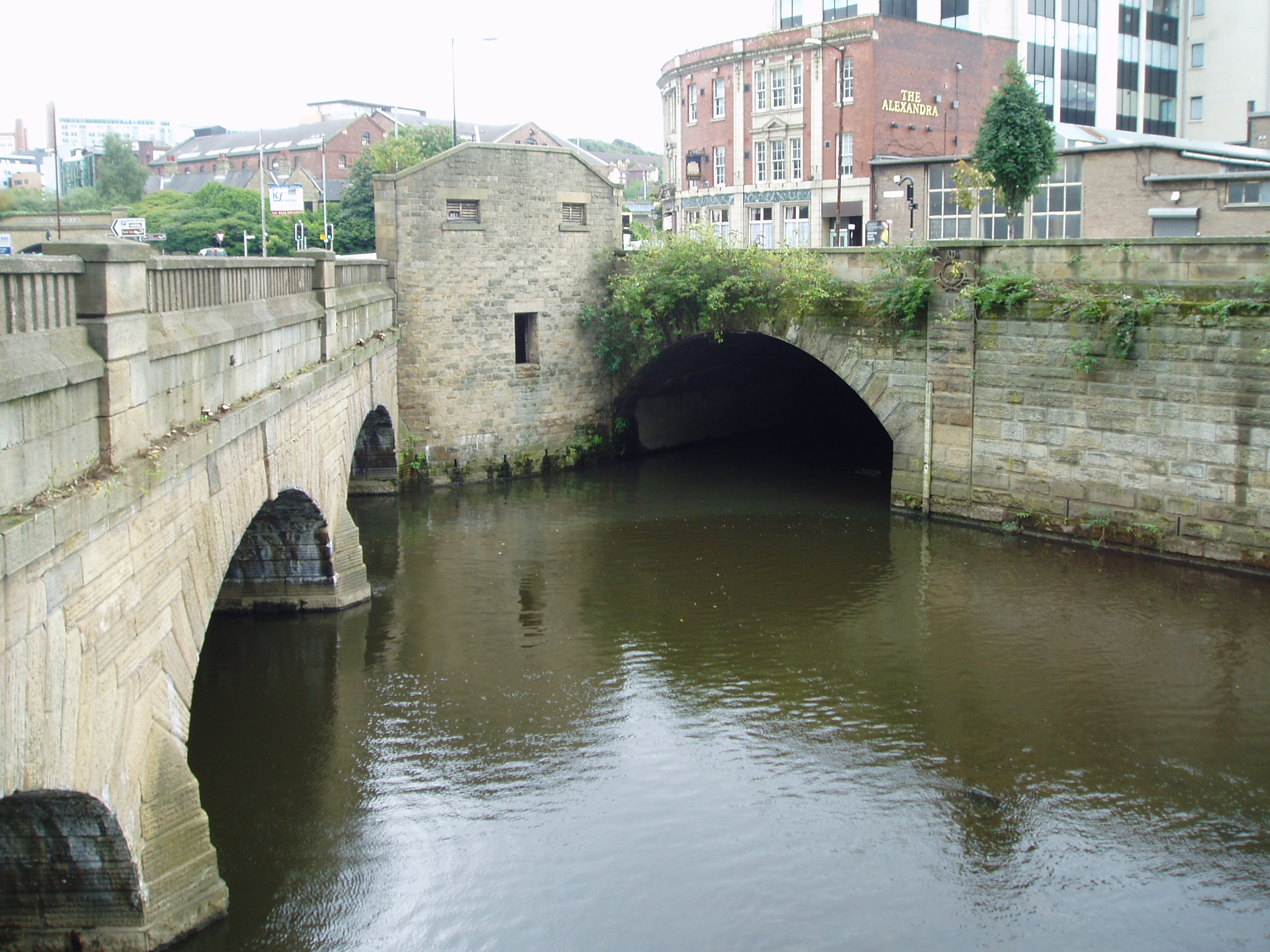
The River Sheaf’s junction with the Don, the arch on the right, 
with Blonk Street Bridge, seen on the left.
(From Wikipedia)
The building of the culvert, now known to Urban Explorers as “The Megatron”, started in about 1850 when the section between the Sheaf Bridge (on Broad Street), and the Canal Bridge (on Exchange Street) was covered to  create the Castlefolds Market which stood between the existing Corn Exchange and the new Norfolk Market Hall.  Later sections were added over the years and the Sheaf Bridge and Canal Bridge were lost and forgotten.

But are they still there buried in the culvert?  This posting gives a glimpse into some research I did recently to try and untangle the story of the culvert and to try and find the old bridges.

Saturday, 22 April 2017

Did a bit of Hartshead, Sheffield, end up in Washington DC?

Did an American Journalist make a pilgrimage to Sheffield (UK) in 1868 to find the shop where his old employer was born amid the radical ferment of the late 18th century?

Did he buy the old frontage of the shop, have it made into a couple of boxes, and donate one to the National Museum in Washington DC (as in USA)?

It's a great story, and it has been interesting trying to follow the trail.  Here is what I think I know about the story ..... (spoiler! I still don't know the answer to all of the above questions!)

Saturday, 3 December 2016

Random Mutation and Evolutionary Change


A few months ago someone made a comment that he had difficulty reconciling evolution's reliance on Random Mutation with what he saw as Ordered Change over time as the environment changes.  This set me thinking, would it be possible to simulate such random changes and couple them with a changing environment to see what might happen.

This post gives a brief flavour of what I managed to achieve - taking a VERY simplified organism, in a VERY simple world.  Throw in a bit of programming, and out comes a simple Windows program which allows the user to play with the numbers and see the results.  The image on the right is one such output - a single organism (at the top) living in an environmental niche (the green stripe) reproduces and multiplies over successive generations (the grey/black stripes down the image).  It soon populates the whole width of the niche, though individuals tend to die out or fail to reproduce at the extremes of the niche.  Then the environment changes - shifting from green to orange - and the random mutations over the generations allow the population to 'adapt' to the changes.  BUT then the environment shifts more quickly - from orange back to green and over to blue.  The rate of  'evolution' within the population can't keep pace, and the entire population dies out.  Woops! Extinction!

A more complete explanation of the model can be found in this PDF (590kb)  which also explains how to use the software, which is available in this ZIP file (2.7mb).  As I say in the notes - Go Play!

Monday, 5 September 2016

LIDAR imaging of the Hilltop Enclosure and Field System in Ecclesall Woods, Sheffield

 An earlier post (here) outlined some of my 'playing' with LIDAR data from the data.gov.uk web-site, this post outlines some of my results.
Hillshaded image of LIDAR DTM data for Ecclesall Woods

The main area I looked at was the high ground to the west of the 'bird sanctuary' centered at about  SK317822.  This area had been investigated by Archaeological Survey and Evaluation Ltd. (ASE Ltd.) in 2002 and 2006 on behalf of the Friends of Ecclesall Woods (FEW).  Their reports (and others on Q-pits) can be found on the FEW web-site (www.friendsofecclesallwoods.org.uk) - I hope they will forgive me for using their results.

Sunday, 4 September 2016

Playing with LIDAR data for Ecclesall Woods, Sheffield

I decided that it was about time I resurrected my Miscellany blog after a two year break, and I thought I would start with a bit of 'playing' that I have been doing over the last few days.
LIDAR Surface Model of the SMEE site at Ecclesall Woods, Sheffield
LIDAR Surface Model of the SMEE site at Ecclesall Woods

John Hunter, a fellow 'researcher' who is far more knowledgeable and hard working than I am, recently mentioned that the Environment Agency has placed LIDAR data for almost the whole country on the data.gov.uk web-site - the data for the 10km square around Sheffield can be found at www.geostore.com/environment-agency/survey.html#/survey?grid=SK28 .  This coincided with a walk around Ecclesall Woods here in sunny Sheffield, and I wondered whether the Q-pits and other structures that I knew existed in the woods might be visible on the LIDAR data.  So that meant it was play-time!

Sure enough, lots of structures were visible, and this posting outlines the process I followed - a separate post (here) will look at what I found.

Friday, 21 February 2014

Tour of the Don (Annotated) - Published as paperback and Kindle edition


A late thought - I omitted to post about the publication of the 'Tour of the Don' which I mentioned in earlier posts - Volumes 1 and 2 are now available on Amazon - just follow the link.

Beauchief Abbey Altar-piece

 I have been exercising my mind over the last week or so trying to find the current location and status of the altar-piece from Beauchief Abbey here in Sheffield.  This is the story so far...

Sunday, 9 September 2012

Fossil Trees found at Brightside, Sheffield, 1896

The following cuttings relate to a number of fossil trees that were unearthed during excavations at Brightside Station, in Sheffield, in 1896.  One of the examples is currently on show in the 'What on Earth' Gallery at Weston Park Museum in Sheffield, and photographs of a couple of the finds are on 'Picture Sheffield'. 

Another example of fossil trees was found at Wadsley in 1933, and may well be the subject of a later posting.

Friday, 7 September 2012

"Survey of the Manor of Sheffield" by John Harrison - 1637

"An exact and perfect survey and view of the Manor of Sheffield with other lands" was compiled by John Harrison for the Earl of Arundel and his family at the time they inherited the manor, via his wife Alethea, on the extinction of the male line of the Earls of Shrewsbury.  It was transcibed by James George Ronksley in 1908 and published privately.  These notes are taken from that edition (available at Sheffield Libraries).

I have only transcribed the Introduction (by R E Leader) and Harrison's Preamble and Description of the Manor - I leave the remaining 400 or so pages of details of land holdings and rents to someone else!  My main interest was to place into context a couple of quotes relating to the birds and fish found within the manor - these can be found towards the end of the description.

While I have tidied up the text to some extent, the spellings and punctuation (and capitalisation!) used in Harrison's text are as they were transcribed by Ronksley.  I may get round to rendering these sections into modern english at some time and adding some further annotation!  (If someone else did that in the meantime, I would gladly add their offering to the site, with due acknowledgement.)  Ronksley's footnotes have been included within the text (in [ ] as are other notes).

(Having done this work, and when about to press 'Publish', I have found that a previous transcription of the Description had appeared in the 'Sheffield History Chat Forum' in 2008 (see link) - apologies to 'Bayleaf', I had no intention of treading on his toes, and can asure him that, other than a meaning for 'Hearnshewes', I have not copied his work.)

Friday, 31 August 2012

The writing of "The Tour of the Don" by John Holland

The following extract is taken from the "Life of John Holland of Sheffield Park : from numerous letters and other documents furnished by his nephew and executor, John Holland Brammall" by William Hudson (available on Internet Archive).  It describes the writing of "The Tour" and gives insights into the character of its author.

Tuesday, 28 August 2012

"Tour of the Don" by John Holland, 1837

"The Tour of the Don" was published weekly through 1836 as a series of articles in the Sheffield Mercury newspaper.  They were brought together as two volumes and re-published in 1837 with the subtitle "A series of extempore sketches made during a pedestrian ramble along the banks of that river, and its principal tributaries".

Monday, 27 August 2012

Hail Storm - Sheffield - 5th July 1843

This post describes the Hail Storm on the 5th July 1843 which did a great deal of damage in Shefield and surrounding areas, including breaking 5700 panes of glass in the Botanical Garden greenhouses.

It is rather a long piece of text from the Sheffield and Rotherham Independent for 8th July 1843, which I have included in its entirety, plus some follow-up articles from the same newspaper, and an account of a further storm in August of the same year.

Sunday, 26 August 2012

The Great Snow Of 1614-15 - from Youlgreave Parish Register


The following notes are extracted from Notes and Queries, 4th Series, Vol 3, No 53, Jan 2, 1869 - p16. (cleaned up from OCR text from Google Books).  They were included, with many other historic weather references, in a recent book which I co-authered entitled "Sheffield's Weather" - available from the Sorby Natural History Society.  What follows adds a bit of context to the extract.

Tuesday, 21 August 2012

"The Vital Statistics of Sheffield" by G.Calvert Holland, 1843

The volume of "Vital Statistics" was produced at the suggestion  of The Town Trustees of Sheffield, who also paid for some of the work.  The work was undertaken by Dr Calvert Holland who is described as "Physician Extraordinary to the Sheffield General Infirmary".